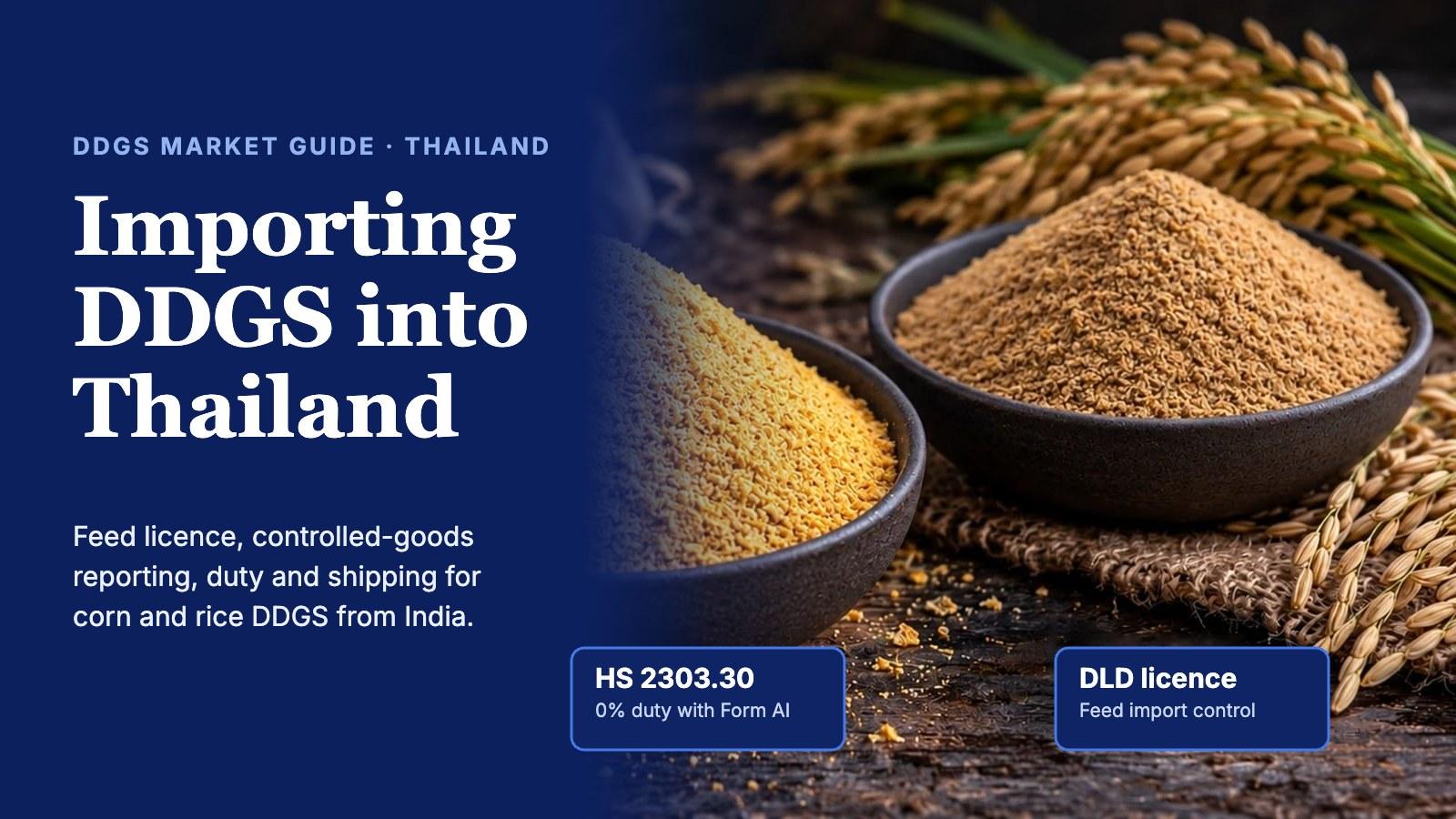
Quick answer: To import DDGS into Thailand, the importer needs an animal feed import licence from the Department of Livestock Development (DLD), and must clear each shipment with the DLD's feed inspection officer at the port, with an import notification, invoice, packing list, bill of lading, certificate of origin and a Certificate of Analysis for the lot. DDGS is classified under HS 2303.30. Indian DDGS can enter at 0% import duty under the ASEAN–India Free Trade Agreement with a Form AI certificate of origin, and animal feed is exempt from Thai VAT. DDGS is on the Ministry of Commerce's controlled goods list, so importers also register and report their DDGS imports and sales each month, but USDA reported in January 2026 that there is no import restriction on DDGS.
Why Thai feed mills buy imported DDGS
Thailand has a large feed industry for poultry, pigs and shrimp, and imports about 50–60% of its feed ingredients, according to USDA. Domestic corn does not meet demand, and imports of feed corn and feed wheat are tightly controlled. DDGS has filled part of that gap: Thailand imported 252,622 tonnes of DDGS from January to November 2025, up 13% on the year before, which USDA put down to attractive prices and no import restriction.
India is a short sea route to Bangkok and Laem Chabang, and Indian ethanol plants now produce two types of DDGS. Corn DDGS (about 29% protein and 10% fat) supplies protein and energy for poultry and pig feed. Rice DDGS (45% protein minimum, 3% fat maximum) is the high-protein option, used in fish and shrimp feed. Our corn vs rice DDGS comparison explains which suits which feed.
Rules that apply to DDGS imports
Requirement | Agency | Notes |
|---|---|---|
Animal feed import licence | Department of Livestock Development (DLD), Division of Animal Feed and Veterinary Products Control | Animal Feed Quality Control Act B.E. 2558 (2015). Only licensed companies may import and sell feed and feed ingredients. |
Product registration or notification | DLD | "Specifically controlled" animal feed must be registered before import. Ask your importer which category DDGS falls under today. |
Port clearance of each shipment | DLD feed inspection officer at the port | Feed import notification with the shipping documents and Certificate of Analysis |
Controlled goods: registration and monthly reports | Ministry of Commerce, Department of Internal Trade | DDGS was added to the controlled goods list in 2020. Importers register and report DDGS imports and sales monthly. No quota or import ban applies to DDGS. |
Do not confuse DDGS with feed corn and feed wheat, which have their own rules. Feed wheat import permits require buying three tonnes of Thai corn for every tonne imported, and feed corn imports face quotas, import windows and a planned "burn-free" origin certificate. USDA confirms these rules apply to corn and wheat, not to DDGS.
Documents with each shipment
Commercial invoice, packing list and bill of lading
Certificate of Analysis for the lot (protein, fat, fibre, moisture, ash and aflatoxin)
Certificate of origin Form AI, to claim the ASEAN–India preferential tariff
Product information and label details: name, type, intended animal, net weight, packing and the producer's address
Copies of the importer's feed import licence and any product registration
Phytosanitary certificate, if your importer or the authority asks for one. We can arrange it from India.
A non-GMO statement where the buyer asks for it. India does not permit commercial cultivation of genetically modified maize or rice.
Older USDA guidance (2013) listed DDGS among the "feed stuffs" for which the importer submits a label sample, a 500-gram sample and a laboratory analysis when registering, and gave a Thai quality standard of 24% protein minimum and 12.5% moisture maximum for DDGS meal. Thailand's feed law was replaced in 2015, so confirm the current documents and standards with your importer or the DLD before the first shipment.
Import duty and VAT
Item | Rate |
|---|---|
HS code | 2303.30 (brewing or distilling dregs and waste) |
Most-favoured-nation import duty | About 9% (statutory ceiling 10%); confirm with your broker |
ASEAN–India FTA rate, with Form AI | 0% (2303.30 was phased to zero under Thailand's AIFTA schedule) |
VAT | Exempt: the Revenue Code exempts sales of animal feed from VAT (Section 81(1)(d)); confirm the import treatment with your broker |
Tariff and tax rules change, so check current rates with your customs broker before you sign a contract.
Ports and shipping
Laem Chabang: Thailand's main container port, on the eastern seaboard.
Bangkok (Khlong Toei): for feed mills in Bangkok and the central plains.
Packing: 50 kg PP bags or jumbo bags (FIBC), powder or pellets, with a minimum order of one full container load.
Quality points to agree in the contract
Protein and fat: agree the minimum protein and maximum fat based on whether you buy corn or rice DDGS.
Moisture: our rice DDGS is supplied at 12% moisture maximum, and recent corn DDGS lots tested at about 7.5%. Thailand's heat and humidity make dry, ventilated storage important.
Aflatoxin: our rice DDGS is supplied at 30 ppb maximum. For corn DDGS, tell us the limit your mill needs and we will confirm whether a lot meets it before shipment.
Samples: approve a sample and the Certificate of Analysis before the order is confirmed.
Step-by-step: your first DDGS order from India
Confirm your company holds a DLD feed import licence and is registered for DDGS with the Ministry of Commerce.
Choose corn or rice DDGS, powder or pellets, and the packing.
Ask us for a quotation, specification, sample and the documents your importer needs.
Agree the contract and payment terms.
We load the container and send the shipping documents, Certificate of Analysis and Form AI.
Your customs broker files the feed import notification with the DLD at the port and clears the goods.
Buy DDGS for Thailand from Polybridge Ventures
Polybridge Ventures LLP supplies corn and rice DDGS from India to feed mills and importers across Southeast Asia. Read our DDGS buyer's guide, see how corn DDGS fits poultry feed and rice DDGS fits shrimp and fish feed, compare DDGS with soybean meal, see all DDGS grades, or request a quote for delivery to Laem Chabang or Bangkok. Import notes for other markets: Malaysia, Vietnam, Indonesia, Philippines and Bangladesh.
Sources: USDA FAS Bangkok, Grain and Feed Monthly TH2026-0002 (January 2026); USDA FAS Bangkok, "DDGS listed on the Controlled Commodities" (July 2020); USDA FAS Bangkok, Animal Feed Import Regulation TH3023 (February 2013); USDA FAS Bangkok, Grain and Feed Annual TH2024-0018; Animal Feed Quality Control Act B.E. 2558 (2015), as summarised by Tilleke & Gibbins; Thai Revenue Code, Section 81 (Revenue Department); ASEAN–India FTA tariff schedule of Thailand (ASEAN Secretariat). This guide is for information only. Check current rules with your customs broker and Thai authorities before importing.