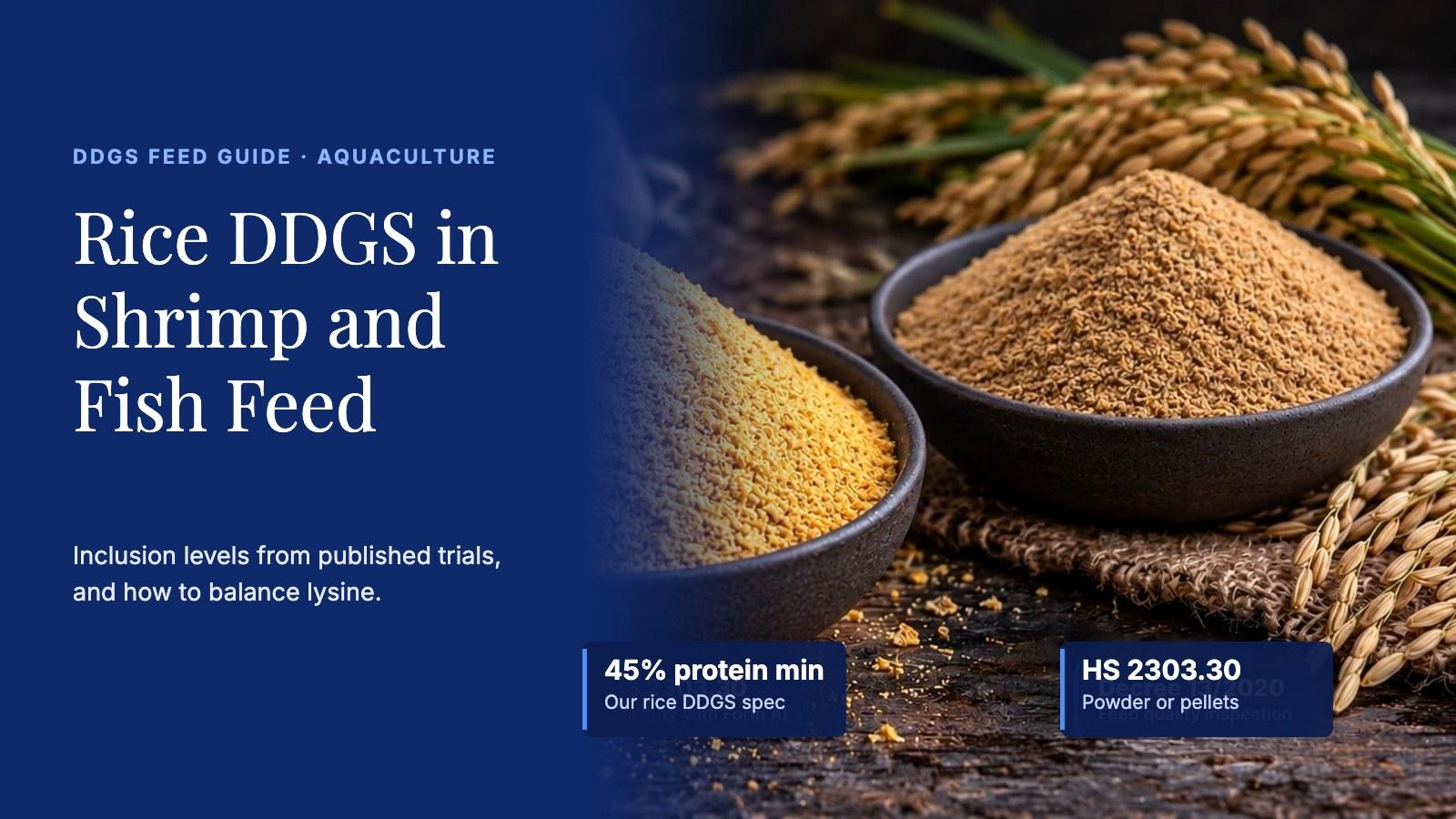
Quick answer: Rice DDGS can replace part of the soybean meal or other plant protein in fish feed. In a 2025 carp trial it went up to 12% of the diet with no loss of growth, and up to 30% (the highest level tested) when 0.1% L-lysine was added. Lysine is the main limit. We found no published shrimp trial on rice DDGS, so in shrimp feed start low and confirm with your own feeding trial. Your nutritionist should set the final level from the analysis of each lot.
Our rice DDGS specification
These are the limits on the Certificate of Analysis for every lot of our rice DDGS.
| Parameter | Limit |
|---|---|
| Crude protein | 45% minimum |
| Crude fat | 3% maximum |
| Crude fibre | 6% maximum |
| Moisture | 12% maximum |
| Ash | 5.5% maximum |
| Aflatoxin | 30 ppb maximum |
High protein and low fat make rice DDGS a protein ingredient, not an energy source. If you are still choosing between the two types, see corn DDGS vs rice DDGS.
Why lysine sets the limit
Lysine is the amino acid that runs short first when rice DDGS replaces soybean meal or fishmeal. A 2024 study of 16 batches of rice DDGS from an Indian rice-only ethanol plant measured about 40% crude protein and 1.19% lysine, so lysine was only about 3% of the protein. The authors of the 2025 carp trial describe lysine as the most limiting essential amino acid in rice DDGS compared with soybean meal, and note that some lysine is damaged during drying.
So the question is not only how much rice DDGS to use, but how much lysine the rest of the formula supplies.
What published trials found in fish
| Species | What rice DDGS replaced | Levels tested (% of diet) | Result | Study |
|---|---|---|---|---|
| Mrigal carp (Cirrhinus mrigala) | Soybean meal | 0–30% | No loss of growth up to 12% without added lysine. With 0.1% L-lysine, the authors found it can be used up to 30%, the highest level tested. | Banik et al., 2025 |
| Red seabream (Pagrus major) | Wheat flour and corn gluten meal | 0–25% | No significant effect on growth, feed efficiency or health up to 25%. | Choi et al., 2014 |
| Olive flounder (Paralichthys olivaceus) | Part of the fishmeal | 0–35% | No negative effect up to 21%. Growth and feed efficiency fell at 28% and above. | Bae et al., 2015 |
The carp trial is the closest match to Indian rice DDGS. The two Korean trials used a different product: the flounder trial used grains from rice-wine (makgeolli) production, and the ingredient in the seabream trial had only about 19% protein. Treat their results as a guide to how fish accept rice distillers grains, not as a level for a 45% protein product.
Shrimp: what is known
We did not find a published feeding trial of rice DDGS in shrimp. Trials with other DDGS products in Pacific white shrimp (Litopenaeus vannamei) give a sense of scale:
- DDGS replacing fishmeal at 0–16% of the diet gave the best growth and feed conversion at 8%. Shrimp on the 8% diet also had lower mortality in a disease challenge (50.9% against 68.3% in the control) (Gyan et al., 2021).
- A high-protein distillers dried grain product could replace corn protein concentrate at up to 20% of the diet, and fishmeal at up to 15%, without affecting growth (Guo et al., 2019).
Based on these, a cautious approach is to start rice DDGS in shrimp feed at a low level, in the range where other DDGS products performed well, and raise it only after your own trial. Confirm the level with your nutritionist.
How to balance lysine in your formula
- Formulate on the lot analysis. Use the protein and amino acid values for the lot you are buying, not book values. Rice DDGS varies with the plant and the process.
- Add L-lysine at higher inclusion. In the carp trial, adding 0.1% lysine let rice DDGS go well beyond 12% of the diet without losing growth.
- Keep a complementary protein. Fishmeal or soybean meal supplies the lysine that rice DDGS lacks, so replace part of them, not all, unless your trial supports it.
- Check methionine as well. Once lysine is corrected, make sure the next limiting amino acids still meet the species' requirement.
- Run a pilot batch. Check pellet durability and water stability before full production, then run a feeding trial at your planned level.
Quality points for aquafeed buyers
- Aflatoxin: fish and shrimp are sensitive to mycotoxins. Our rice DDGS is supplied at 30 ppb maximum, confirmed on the Certificate of Analysis for each lot. If your mill works to a tighter limit, tell us before you order.
- Moisture: 12% maximum. Store bags dry and off the floor, especially in humid climates.
- Samples: approve a sample and its Certificate of Analysis before the order is confirmed.
Buying rice DDGS from India
We export rice DDGS under HS code 2303.30, as powder (meal) or pellets, packed in 50 kg woven PP bags or jumbo bags (FIBC). The minimum order is one full container load, and a Certificate of Analysis comes with every lot. For import rules in major aquaculture markets, see our guides for Vietnam, Indonesia, Bangladesh and the Philippines, or the main DDGS import guide.
To get a quotation, specification and sample, contact us.
Sources
- Banik A. et al. (2025). Total replacement of soybean meal by rice distilled dried grain soluble (DDGS) with lysine supplementation in carp (Cirrhinus mrigala). Aquatic Living Resources 38: 9.
- Kurechiya N. et al. (2024). Chemical and nutritional composition of rice distiller dried grain with solubles for livestock and poultry. Exploratory Animal and Medical Research 14(2).
- Choi J., Rahman M.M. and Lee S.M. (2014). Rice distillers dried grain as a partial replacement of plant origin sources in the diet for juvenile red seabream. Asian-Australasian Journal of Animal Sciences 27(12): 1736–1743.
- Bae K.-M., Kim K.-W. and Lee S.-M. (2015). Evaluation of rice distillers dried grain as a partial replacement for fish meal in the diet of juvenile olive flounder. Fisheries and Aquatic Sciences 18(2): 151–158.
- Gyan W.R. et al. (2021). Effects of replacing fishmeal with dried distillers grains with solubles in Litopenaeus vannamei juveniles. Aquaculture Reports 21: 100821.
- Guo J. et al. (2019). Using high protein distiller's dried grain product to replace corn protein concentrate and fishmeal in diets for Pacific white shrimp. Journal of the World Aquaculture Society 50(5): 983–992.
Inclusion levels are from published research and are a starting point only. Results depend on species, life stage, the rest of the formula and the lot analysis. Confirm levels with your nutritionist.