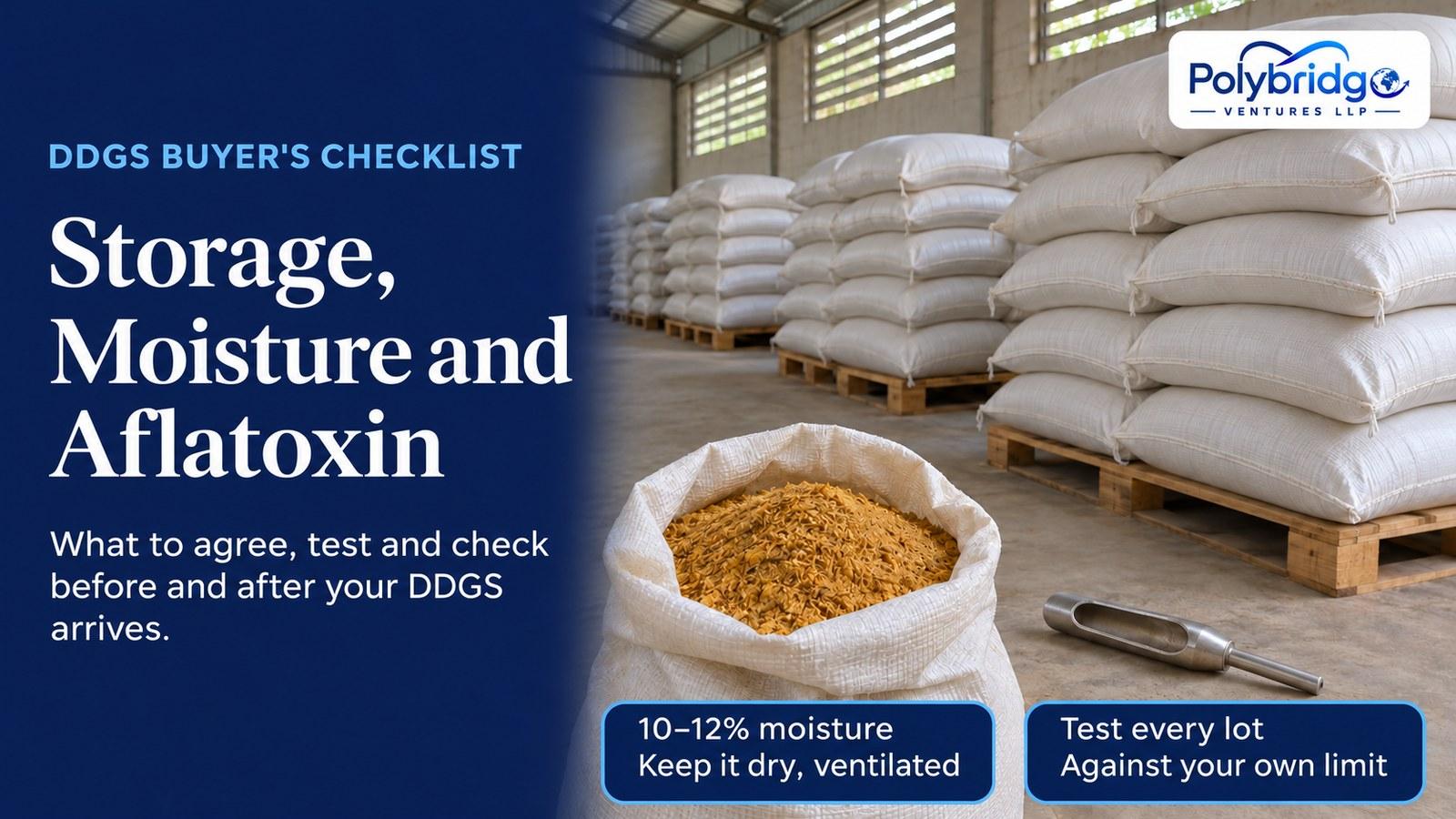
Quick answer: DDGS stays in good condition when it arrives dry and stays dry. It is usually dried to 10–12% moisture, and it absorbs water from humid air, which causes caking and, if moisture keeps rising, mould. Because mycotoxins in the grain end up concentrated in DDGS, at up to about three times their level in the original corn, every lot should come with a test report and be checked against your own market's aflatoxin limit. Agree the limit, the sampling method and the test method in the contract, and store bags off the floor in a dry, ventilated warehouse.
Why DDGS needs careful handling
- It absorbs moisture. DDGS is hygroscopic. In research summarised by the U.S. Grains Council, moisture bridges between particles started to form at about 60% relative humidity and hardened into solid bridges at 100%, which did not reverse.
- Wet DDGS can go mouldy. In a 28-day test at 38°C and 90% relative humidity, DDGS moisture rose from 10.2% to 21.4%, and significant mould growth followed.
- Mycotoxins concentrate. Fermentation removes the starch but not the mycotoxins, so their concentration in DDGS can be two to three times that of the grain it was made from.
- Warm loading causes caking. DDGS loaded warm, before it has cooled and equilibrated, can harden in trucks, rail cars and containers.
Checklist 1: before you order
- Agree the moisture maximum. Our rice DDGS is supplied at 12% maximum; recent corn DDGS lots tested at about 7.5%.
- Agree protein and fat for the type you buy: rice DDGS 45% protein minimum and 3% fat maximum; corn DDGS about 29% protein and 10% fat (typical values, not a guarantee).
- State your aflatoxin limit, and say whether it is for aflatoxin B1 or total aflatoxins (B1 + B2 + G1 + G2). Different countries regulate different measures.
- Ask for the test report for each lot before shipment, and name the test method you accept (rapid kit or laboratory method).
- Agree how the sample is taken and who keeps a retained sample.
- Choose powder or pellets. Pellets are denser and flow better out of bins and bags.
- Agree the packing: 50 kg woven PP bags or jumbo bags (FIBC).
Aflatoxin limits to check
There is no single worldwide limit. These are two widely used references. Check your own country's rule before you set a contract limit.
| Market | Product | Limit |
|---|---|---|
| European Union and UK (aflatoxin B1, at 12% moisture) | Feed materials such as DDGS | 0.02 mg/kg (20 ppb) |
| European Union and UK | Compound feed for dairy cattle, calves, piglets and young poultry | 0.005 mg/kg (5 ppb) |
| United States (total aflatoxins, FDA action levels) | Feed for immature animals, dairy animals or unknown use | 20 ppb |
| United States | Corn products for breeding cattle, breeding swine and mature poultry | 100 ppb |
| United States | Corn products for finishing swine over 100 lb | 200 ppb |
| United States | Corn products for finishing (feedlot) beef cattle | 300 ppb |
Our position: our rice DDGS is supplied at 30 ppb aflatoxin maximum. If your market's limit is lower, tell us and we will confirm per lot whether it can be met. For corn DDGS we do not quote a fixed aflatoxin figure: tell us your limit, and we confirm each lot against it before shipment.
Checklist 2: sampling and testing
- Sample from many points. Aflatoxin is unevenly spread through a lot. Studies of aflatoxin testing found that sampling causes most of the variation in results, far more than the laboratory method itself.
- Take composite samples. Combine many small samples from different bags or points into one large sample. DDGS separates by particle size, with fine particles collecting in the centre and coarse particles at the sides, so one grab sample can give a misleading result.
- Grind and mix the whole sample before the test portion is taken.
- Screen, then confirm. Rapid test kits (ELISA or lateral-flow strips) are quick screening tools. Laboratory methods such as liquid chromatography (HPLC or LC-MS) take longer but measure more precisely. Use a laboratory result where a contract limit is at stake.
- Keep a retained sample from each lot, sealed and labelled, in case of a dispute.
Checklist 3: when the container arrives
- Check the container for damage, water marks and condensation before unloading.
- Look for wet, torn or stained bags, lumps, a musty smell or warm spots. Set these aside and photograph them.
- Check moisture on arrival and compare it with the test report.
- Sample the lot as agreed, and hold it until the result is back if it is going into feed for sensitive animals.
Checklist 4: storage
- Store bags on pallets, off the floor and away from walls, in a dry, roofed and ventilated warehouse.
- Keep the storage area dry. Grain storage guidance aims for relative humidity below about 70% to prevent mould.
- Keep moisture at or below about 12%. DDGS that picks up moisture in humid storage is more likely to cake and go mouldy.
- Use the oldest stock first (first in, first out), and do not stack new bags on top of older ones.
- Avoid large temperature differences within stored product, which drive moisture migration.
- Check stocks regularly for lumps, warmth, smell or insects.
- Ask your nutritionist about a mould inhibitor or antioxidant if you store DDGS for long periods in a hot, humid climate. Research has shown antioxidants can reduce fat oxidation in stored DDGS.
Buy tested DDGS from Polybridge Ventures
Polybridge Ventures LLP exports corn and rice DDGS from India with a laboratory test report for every lot. Read our DDGS buyer's guide, compare corn and rice DDGS, see how DDGS fits poultry feed and shrimp and fish feed, check the import rules for Thailand, Malaysia, Vietnam, Indonesia, Philippines and Bangladesh, see all DDGS grades, or tell us your aflatoxin limit and request a quote.
Sources: U.S. Grains Council DDGS handbook, Chapter 9, "Physical and Chemical Characteristics Related to Handling and Storage of DDGS"; U.S. FDA Compliance Policy Guide Sec. 683.100, Action Levels for Aflatoxins in Animal Food; Directive 2002/32/EC on undesirable substances in animal feed, Annex I (aflatoxin B1), as retained in UK law; Siegel, "Testing for mycotoxin in poultry feed ingredients", WATTPoultry (2011); Jones, "Avoiding mycotoxins in corn feedstock and DDGS", WATTPoultry; Whitaker et al., sampling variability in aflatoxin testing (University of Georgia Feed the Future Peanut Lab summary). Limits change and differ by country, so confirm the rule that applies to you with your feed authority or nutritionist.