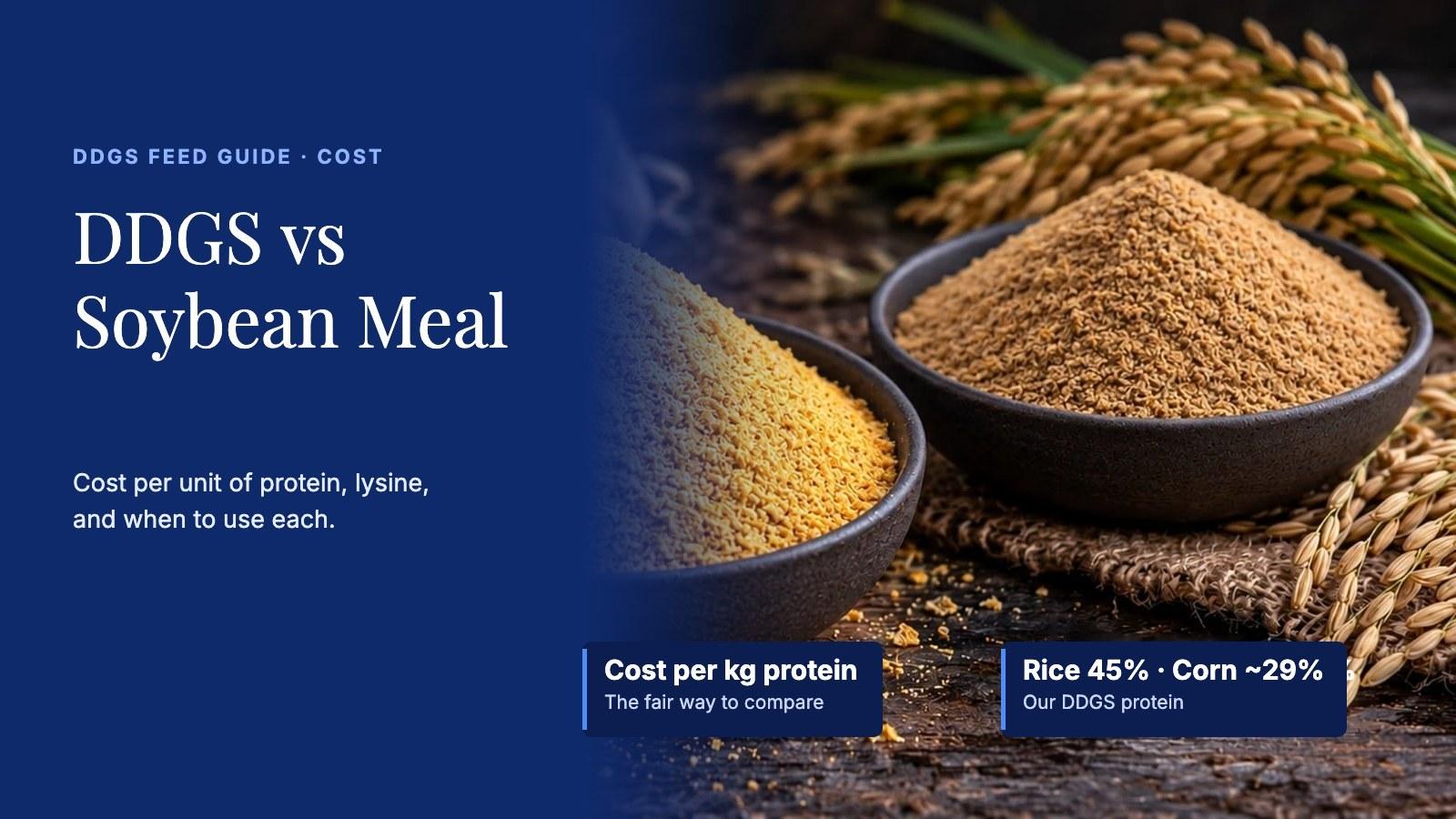
Quick answer: Compare DDGS and soybean meal on cost per kilogram of protein, not price per tonne. Soybean meal has more protein and about twice as much lysine per kilogram of protein, so DDGS replaces part of the soybean meal (and part of the maize), not all of it. A US government study found that one tonne of DDGS replaced about 1.05 tonnes of corn and soybean meal in poultry feed. With Indian soybean meal prices up nearly 60% in a year, the comparison is worth running on every purchase.
Why this comparison matters in 2026
According to the Solvent Extractors' Association of India, the average Indian port price of soybean meal rose from US$385 a tonne in July 2025 to US$617 a tonne in July 2026, an increase of nearly 60%. Soybean meal is the main protein source in poultry, aqua and livestock feed, so feed mills are looking for ways to use less of it without losing performance.
Protein and lysine side by side
Ingredient | Crude protein | Lysine (% of protein) | Lysine per tonne (calculated) | Fat |
|---|---|---|---|---|
Soybean meal (44–48% type) | About 46% (example) | About 6.2% | About 28.5 kg | About 2% |
45% minimum | About 3% | About 13.5 kg | 3% maximum | |
About 29% (recent lots) | About 3% | About 8.7 kg | About 10% |
Lysine figures are published averages: soybean meal and corn DDGS from Feedipedia, rice DDGS from a 2024 study of Indian rice DDGS. Lysine per tonne is calculated from those averages, so use your own lot analysis when you formulate.
Two points stand out. Rice DDGS has almost as much protein as soybean meal, but about half the lysine in that protein. Corn DDGS has less protein, but about five times the fat of soybean meal, so it also supplies energy.
How to compare cost per kilogram of protein
Divide the delivered price per tonne by the kilograms of protein in a tonne:
Cost per kg of protein = price per tonne ÷ (protein % × 10)
Worked example using the July 2026 Indian port average for soybean meal, and assuming 46% protein:
Soybean meal: US$617 ÷ 460 kg = about US$1.34 per kg of protein.
Rice DDGS at 45% protein matches that cost per kg of protein at about US$603 a tonne (1.34 × 450).
Corn DDGS at about 29% protein matches it at about US$389 a tonne (1.34 × 290). Because corn DDGS also replaces maize as an energy source, it can be worth more than its protein value alone.
These are break-even figures for illustration, not our prices. Compare landed costs at your port, with the actual protein on each lot's analysis. For a quotation, contact us.
Why DDGS can't replace soybean meal one for one
Cost per kg of protein is a first filter. Your formula still needs enough lysine and the other essential amino acids. Because DDGS has about half the lysine per kg of protein, a diet that swaps soybean meal for DDGS kilo for kilo will usually run short of lysine. Nutritionists solve this by:
replacing part of the soybean meal, not all of it;
adding feed-grade L-lysine (and threonine where needed) as DDGS rises;
formulating on digestible amino acids from the lot analysis, because heat during drying can damage lysine.
Least-cost formulation software does this automatically if you enter accurate DDGS values and current prices.
How much corn and soybean meal does DDGS replace?
A USDA Economic Research Service study (Hoffman and Baker, 2011) estimated how much corn and soybean meal one tonne of DDGS replaced in US feed, under current feeding practice:
Livestock | Corn replaced | Soybean meal replaced | Total replaced |
|---|---|---|---|
Poultry | 0.61 t | 0.44 t | 1.05 t |
Dairy cattle | 0.73 t | 0.63 t | 1.36 t |
Swine | 0.70 t | 0.30 t | 1.00 t |
Beef cattle | 1.20 t | 0 | 1.20 t |
These figures are for US corn DDGS. Rice DDGS has more protein and less fat, so it replaces relatively more soybean meal and less maize.
When to use each
Situation | Best fit |
|---|---|
You need protein and soybean meal is expensive | Rice DDGS, with added lysine |
You need protein and energy (broilers, layers, dairy) | Corn DDGS, replacing part of the maize and soybean meal |
Young animals or diets with very high lysine needs | Keep soybean meal as the main protein; use DDGS at lower levels |
Fish and shrimp feed | Rice DDGS within published inclusion levels |
For inclusion levels by species, see corn DDGS in poultry feed and rice DDGS in shrimp and fish feed. To choose between the two DDGS types, see corn DDGS vs rice DDGS.
Buying DDGS from India
We export corn and rice DDGS under HS code 2303.30, as powder (meal) or pellets, packed in 50 kg woven PP bags or jumbo bags (FIBC). The minimum order is one full container load, and a laboratory report comes with every lot. For corn DDGS, tell us the aflatoxin limit your mill needs and we will confirm whether a lot meets it before shipment. See the DDGS import guide for documents and country rules.
Related guides: DDGS market update, November 2026 (soybean meal prices and India's DDGS supply).
Sources
Solvent Extractors' Association of India data, reported in Oilmeal exports rise 19% in May, soybean meal prices surge nearly 60% in a year. Rural Voice, 19 August 2026.
Soybean meal price surge rattles India's poultry sector. nutriNews, May 2026.
Hoffman L.A. and Baker A. (2011). Estimating the substitution of distillers' grains for corn and soybean meal in the U.S. feed complex. USDA Economic Research Service, FDS-11-I-01.
Feedipedia. Soybean meal, low protein, type 44–46 and Maize distillers grains. INRAE, CIRAD, AFZ and FAO.
Kurechiya N. et al. (2024). Chemical and nutritional composition of rice distiller dried grain with solubles. Exploratory Animal and Medical Research 14(2).
Prices and composition figures are published averages for illustration. Use landed prices at your port and the analysis of each lot, and confirm inclusion levels with your nutritionist.