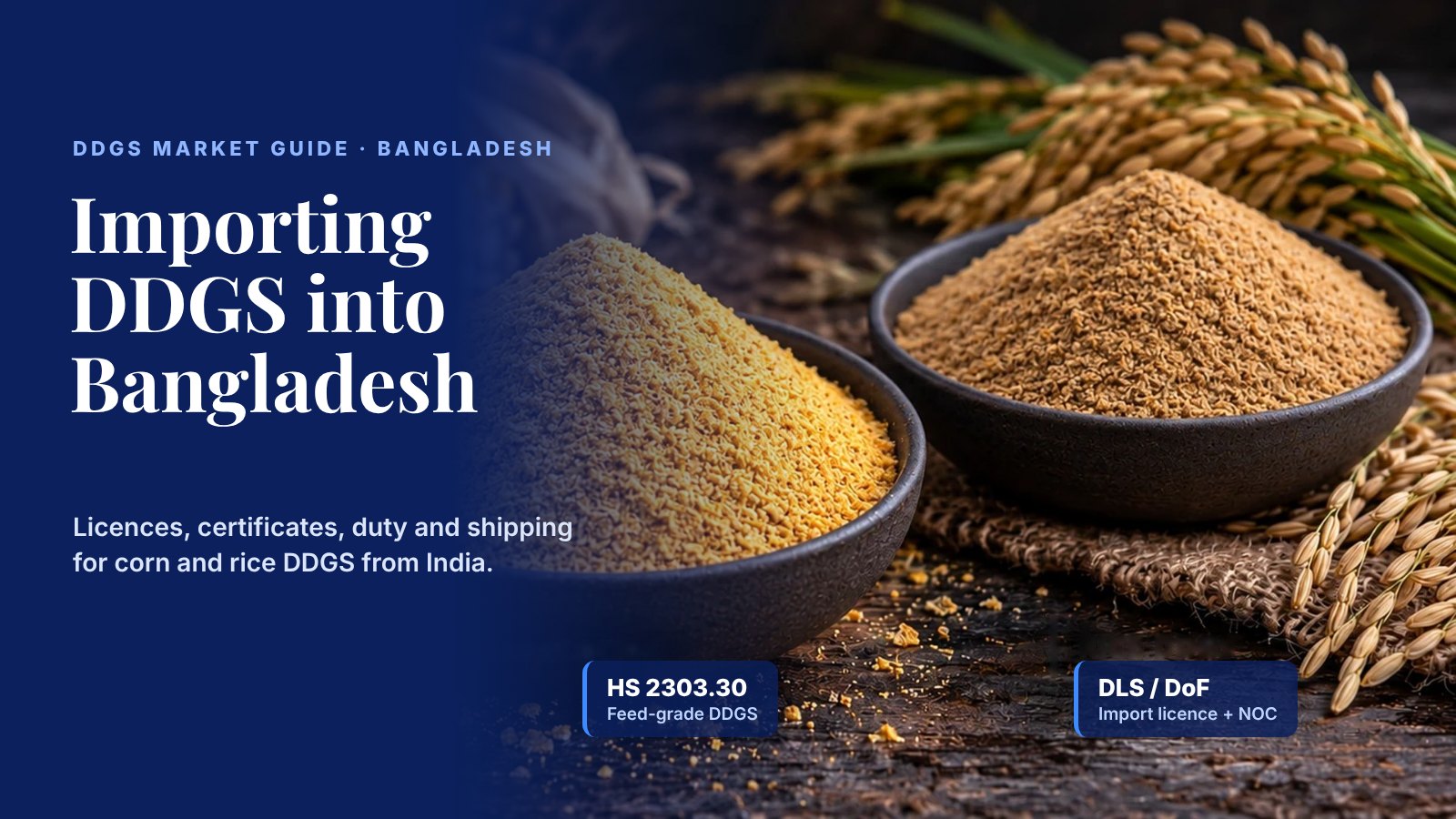
Quick answer: To import DDGS into Bangladesh, the importer needs a feed import licence from the Department of Livestock Services (DLS), or from the Department of Fisheries (DoF) for fish feed, a DLS no-objection certificate (NOC) for the lot, and an agro-products importer licence from the Department of Agricultural Marketing. Each consignment must arrive with a GMO-free certificate and a radioactivity test certificate from the exporting country. DDGS is classified under HS 2303.30. The standard tax incidence is 25%, but feed-grade DDGS can be imported at 0% customs duty, VAT and advance tax when the importer meets the conditions of SRO 128/2020.
Why Bangladeshi feed mills buy DDGS from India
Bangladesh's poultry, fish and cattle feed industry relies on imported protein. Indian DDGS has become a common choice because it is close by and competitively priced. In July 2025 a senior official of Bangladesh's feed manufacturers' association told the press that Indian DDGS could be up to US$100 a tonne cheaper than US DDGS, which matters in a price-sensitive market. Shipping from India to Chattogram is also much shorter than from the Americas.
Indian sellers offer two types. Corn DDGS has about 29% protein and 10% fat, and rice DDGS has 45% protein minimum and 3% fat maximum. Our corn vs rice DDGS comparison explains which suits which feed.
Licences the importer needs
| Licence or permission | Issued by | When |
|---|---|---|
| Feed import licence (animal or poultry feed) | Department of Livestock Services (DLS) | Before import; valid one year |
| Feed import licence (fish feed) | Department of Fisheries (DoF) | Before import |
| No-objection certificate (NOC) for feed ingredients | DLS | Before import, for each lot |
| Agro-products importer licence | Department of Agricultural Marketing (DAM) | Before import; renewed every year |
These licences are the importer's responsibility. We share the product specification, Certificate of Analysis and pro forma invoice early, so the importer can apply for the NOC before the goods are loaded.
Certificates for each shipment
| Certificate | Issued by | When |
|---|---|---|
| GMO-free certificate | Competent authority in the exporting country | Before import |
| Radioactivity test certificate | Competent authority in the exporting country | Before import |
| Fit for fish and animal consumption certificate | Competent authority in the exporting country | Listed as after import |
| Free test certificate for harmful drugs, hormones and steroids, including chloramphenicol and nitrofuran | Government-approved laboratory in Bangladesh | After import |
India does not permit the commercial cultivation of genetically modified maize or rice, which makes the GMO-free certificate straightforward for Indian DDGS. We arrange the GMO-free, radioactivity and fitness certificates through accredited Indian laboratories and authorities, together with the commercial invoice, packing list, bill of lading, certificate of origin, phytosanitary certificate where required, and the Certificate of Analysis for the lot.
Import duty on DDGS in Bangladesh
According to the Bangladesh Customs tariff for HS 2303.30 ("brewing or distilling dregs and waste"):
| Tax | Standard rate | Feed-grade DDGS with SRO 128/2020 conditions met |
|---|---|---|
| Customs duty (CD) | 0% | 0% |
| Regulatory duty (RD) | 0% | 0% |
| Supplementary duty (SD) | 0% | 0% |
| VAT | 15% | 0% |
| Advance income tax (AIT) | 5% | Not listed in the exemption |
| Advance tax (AT) | 5% | 0% (SRO 151/2021) |
| Total tax incidence | 25% | Much lower |
To use the concession, the importer must be registered with DLS, DoF or a recognised feed or poultry association, hold a clearance certificate based on annual requirements, give customs the product literature, chemical analysis and a detailed packing list, and file a utilisation report every six months. Check the current rates with your clearing agent before you place an order, because tariffs and SROs change.
Ports and shipping
- Sea: most container shipments of DDGS go to Chattogram port. Mongla is an alternative for buyers in the south-west.
- Packing: 50 kg PP bags or jumbo bags, with a minimum order of one full container load.
- Land routes: some feed ingredients cross by truck, but each land port has its own list of permitted goods and the rules have changed in recent years. Confirm the route with your clearing agent first.
Quality checks Bangladeshi buyers ask for
- Protein and fat: agree the minimum protein and maximum fat in the contract, based on whether you are buying corn or rice DDGS.
- Moisture: DDGS should stay dry in transit. Our rice DDGS specification is 12% moisture maximum, and recent corn DDGS lots tested at about 7.5%.
- Aflatoxin: Most feed mills set an aflatoxin limit for incoming ingredients. Our rice DDGS is supplied at 30 ppb aflatoxin maximum. For corn DDGS, tell us the limit your mill needs and we will confirm whether a lot meets it before shipment.
- Samples: approve a sample and the Certificate of Analysis before the order is confirmed.
Step-by-step: your first DDGS order from India
- Choose corn or rice DDGS, powder or pellets, and the packing.
- Ask us for a quotation, specification and sample.
- Apply for the DLS NOC using our pro forma invoice and specification.
- Open the letter of credit or agree payment terms.
- We load the container and send the shipping documents and certificates.
- Your clearing agent clears the goods at Chattogram, and the post-import tests are carried out.
Buy DDGS for Bangladesh from Polybridge Ventures
Polybridge Ventures LLP supplies corn and rice DDGS from India to feed mills and importers in Bangladesh and across Asia. Read our general DDGS buyer's guide, see all DDGS grades, or request a quote for delivery to Chattogram.
Sources: Bangladesh Customs Import Export Hub, HS 23033000 product-specific documents, tariff rates and duty benefits (last updated 9 February 2025); SRO 128-Law/2020/79/Customs and SRO 151-Law/2021/148/VAT; Feed Act 2010 and Animal Feed Rules 2013; Tridge news, July 2025. This guide is for information only. Check current rules with DLS, your clearing agent and Bangladesh Customs before importing.