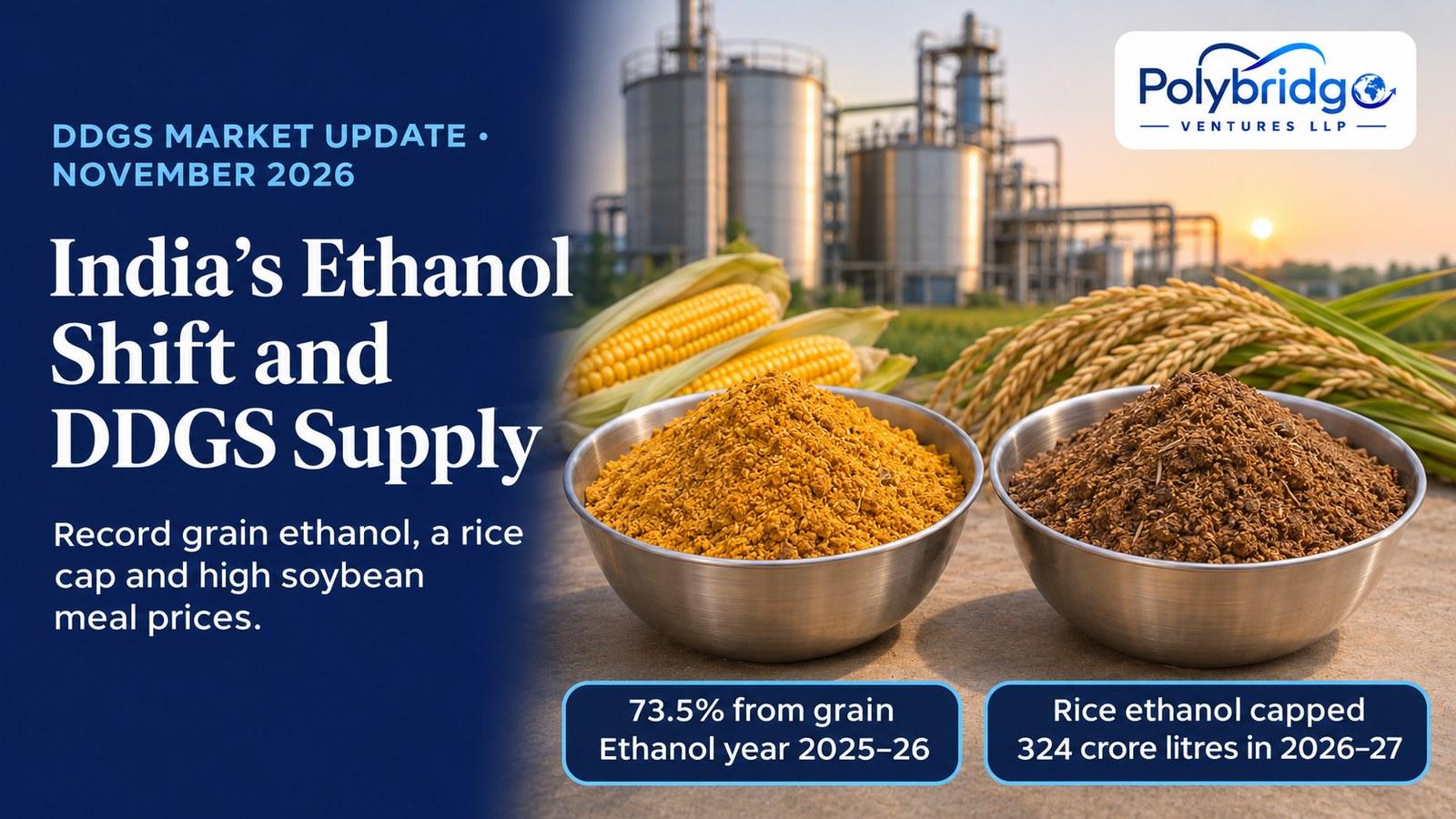
Quick answer: India met its 20% ethanol blending target in the 2025–26 supply year, which ran from November 2025 to October 2026, and grain supplied almost three-quarters of the ethanol. That means record grain-based distilling and record DDGS output. For 2026–27, the government has stopped buying ethanol made from cane juice and B-heavy molasses and capped ethanol from surplus FCI rice, so maize is set to supply an even larger share. For buyers, this points to plentiful corn DDGS and a tighter, more closely watched supply of rice DDGS. Meanwhile Indian soybean meal stayed far above world prices through mid-2026, which keeps DDGS attractive as a cheaper protein source.
1. Ethanol year 2025–26: grain now dominates
Provisional figures released by the All India Distillers' Association (AIDA) on 20 November 2026, covering the year to 31 October 2026:
| Item | 2025–26 |
|---|---|
| Average ethanol blending in petrol | 19.99% |
| Ethanol blended | 1,134.36 crore litres (about 11.3 billion litres) |
| Ethanol from grain | 800.53 crore litres, 73.52% of supplies |
| From maize | 489.71 crore litres, about 80% of its allocation |
| From surplus FCI rice | 233.95 crore litres, about 100% of its allocation |
| From damaged foodgrains | 76.87 crore litres |
| From sugar-based feedstocks | 288.38 crore litres, 26.48% of supplies |
Every litre of grain ethanol leaves DDGS behind, so this is the main driver of India's DDGS supply. Maize is now the largest single feedstock, which means corn DDGS is the larger stream, while rice DDGS comes mainly from distilleries using FCI rice.
2. Ethanol year 2026–27: more maize, capped rice
The oil marketing companies' tender of 16 October 2026 asks for about 1,100 crore litres of ethanol for November 2026 to October 2027. The main changes:
- No cane juice or B-heavy molasses ethanol: the tender seeks no offers for ethanol from sugarcane juice, sugar syrup or B-heavy molasses.
- Rice capped: a corrigendum of 3 November caps ethanol from surplus FCI rice at 324 crore litres, at 108 crore litres a quarter for the first three quarters, and damaged foodgrains at 160 crore litres.
- Prices: the basic rates are ₹60.32 per litre for FCI rice ethanol, ₹64 for damaged foodgrains and ₹66.07 for maize, plus a ₹2.79 incentive for maize.
- Offers: distilleries offered about 1,934.5 crore litres against the 1,100 crore litres tendered, with maize at 1,140.4 crore litres, FCI rice at 457.8 crore litres and damaged foodgrains at 239.6 crore litres.
Grain ethanol makers have asked the government to review prices and allocations, so the rules may still change during the year.
3. Soybean meal: still the expensive protein
- Indian soybean meal averaged about US$617 per tonne in July 2026, up from US$385 a year earlier, according to Solvent Extractors' Association data reported by BigMint.
- In August 2026 it was quoted at about US$622 per tonne, against international benchmarks of about US$445.
- India's soybean meal exports fell 73% in April–August 2026, to about 2.05 lakh tonnes, as the price gap made Indian meal uncompetitive.
When soybean meal is expensive, feed mills look harder at alternative proteins. Our DDGS vs soybean meal guide shows how to compare them on cost per kilogram of protein.
What this may mean for DDGS buyers
- Corn DDGS: with maize carrying more of the 2026–27 ethanol programme, corn DDGS output should stay high. Plan regular shipments and agree lot-by-lot testing, especially for aflatoxin.
- Rice DDGS: the cap on FCI rice ethanol limits how much rice-based distilling can grow, so high-protein rice DDGS may be harder to secure in large volumes. Buyers who rely on it for aquafeed should plan contracts and shipment schedules early.
- Domestic demand: high soybean meal prices push Indian feed mills towards DDGS too, so export buyers compete with local demand.
- Prices: DDGS prices follow grain costs, ethanol output and protein meal prices, and can move quickly. We do not publish prices; ask us for a current quotation.
This is our reading of published data, not a forecast. Check the latest figures before you fix a contract.
Buy corn and rice DDGS from Polybridge Ventures
Polybridge Ventures LLP exports corn and rice DDGS from India with a laboratory test report for every lot. Compare corn and rice DDGS, read our DDGS buyer's guide and storage and aflatoxin checklist, see all DDGS grades, or request a quote.
Sources: All India Distillers' Association data release, 20 November 2026, as reported by Autocar Professional and ThePrint; OMC tender for ESY 2026-27 (16 October 2026) and corrigendum (3 November 2026), as reported by Transclew, Rural Voice and Zee Business; ChiniMandi, "OMCs receive bids for 1,934.5 crore litres of ethanol for ESY 2026-27" (7 November 2026); BioEnergy Times (3 November 2026); Solvent Extractors' Association of India export data, as reported by BigMint and Rural Voice (2026). This update is for information only and is not a price forecast.