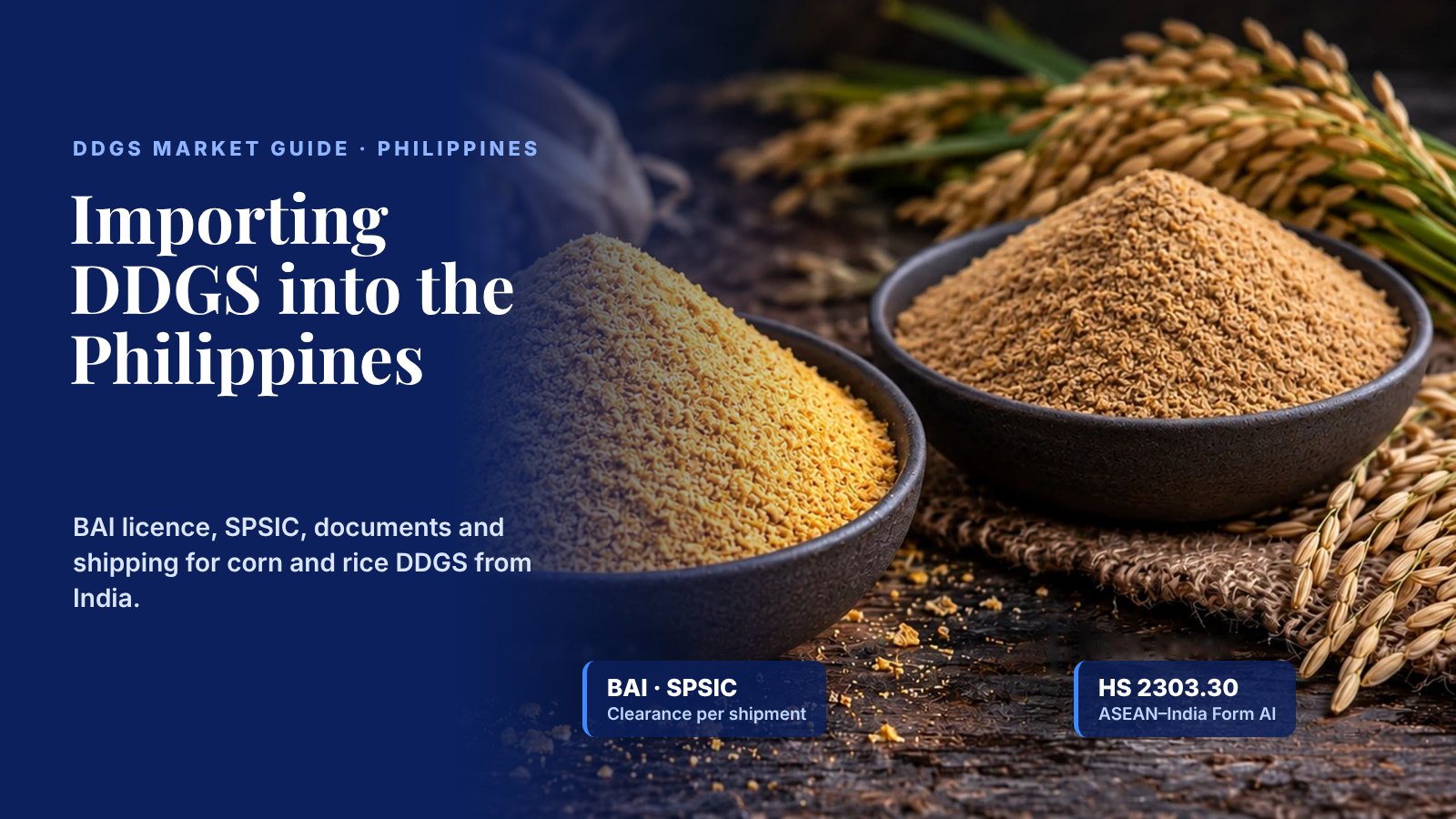
Quick answer: To import DDGS into the Philippines, the importer needs a License to Operate as a feed importer from the Bureau of Animal Industry (BAI), a Certificate of Feed Product Registration for the product, and a Sanitary and Phytosanitary Import Clearance (SPSIC) for each shipment before it is loaded. Feed ingredients must ship within 60 days of the SPSIC being issued. DDGS is classified under HS 2303.30. Preferential duty under the ASEAN–India Free Trade Agreement needs a Form AI certificate of origin.
Why Philippine feed mills buy DDGS
The Philippines has a large hog, poultry and aquaculture feed industry that imports most of its protein meal and part of its grain. DDGS lets feed mills replace part of the corn and soybean meal in a formula. Corn DDGS (about 29% protein and 10% fat) supplies protein plus energy for hog and poultry feed, and rice DDGS (45% protein minimum, 3% fat maximum) suits high-protein poultry, tilapia, milkfish and shrimp feed. Our corn vs rice DDGS comparison explains which suits which feed.
Licences and clearances the importer needs
| Requirement | Issued by | When |
|---|---|---|
| License to Operate as a feed importer | Bureau of Animal Industry, Animal Feeds and Veterinary Drugs and Biologics Control Division | Before the first import |
| Certificate of Feed Product Registration (CFPR) | Bureau of Animal Industry | Before the product is imported and sold |
| Sanitary and Phytosanitary Import Clearance (SPSIC) | Bureau of Animal Industry for feed ingredients | Before loading, for each shipment; ship within 60 days |
| Utilisation report on earlier feed ingredient imports | Bureau of Animal Industry | Required for some feed ingredients since June 2022 |
Department of Agriculture Department Circular 14 (2025) sets out which bureau clears which product. Feed, feed ingredients and feed additives fall under the Bureau of Animal Industry. Each SPSIC covers one shipment, cannot be transferred, and is deemed approved if the bureau does not act on a complete application within seven working days.
Documents with each shipment
- SPSIC issued before loading
- Phytosanitary certificate issued in India
- Commercial invoice, packing list and bill of lading
- Certificate of origin Form AI, to claim the ASEAN–India preferential tariff
- Certificate of Analysis for the lot
- Declaration of GMO content where the bureau asks for it. India does not permit commercial cultivation of genetically modified maize or rice.
At customs, the importer also needs the Authority to Release Imported Goods and, for bulk cargo, a port survey report.
Import duty and VAT
| Item | Treatment |
|---|---|
| HS code | 2303.30 (residues of brewing or distilling) |
| Import duty | Most-favoured-nation rate, or the ASEAN–India rate with Form AI; confirm the current rate with your customs broker |
| VAT | The National Internal Revenue Code exempts livestock, poultry and fish feed ingredients used to make finished feed; specialty feeds are not exempt |
Ports and shipping
- Luzon: Manila (Manila International Container Terminal), Batangas and Subic, close to the feed mills of Central Luzon and Calabarzon.
- Visayas and Mindanao: Cebu and Davao.
- Packing: 50 kg PP bags or jumbo bags, minimum one full container load.
Quality points to agree in the contract
- Protein and fat: agree the minimum protein and maximum fat based on whether you buy corn or rice DDGS.
- Moisture: our rice DDGS is supplied at 12% moisture maximum, and recent corn DDGS lots tested at about 7.5%. Store DDGS dry and ventilated in the humid climate.
- Aflatoxin: our rice DDGS is supplied at 30 ppb maximum. For corn DDGS, tell us the limit your mill needs and we will confirm whether a lot meets it before shipment.
- Timing: plan loading inside the 60-day SPSIC window, and give us the SPSIC number before we book the vessel.
Step-by-step: your first DDGS order from India
- Choose corn or rice DDGS, powder or pellets, and the packing.
- Ask us for a quotation, specification and sample, and the product details for your feed product registration.
- Apply for the SPSIC for the shipment.
- Open the letter of credit or agree payment terms.
- We load the container within the SPSIC window and send the shipping documents, phytosanitary certificate, Certificate of Analysis and Form AI.
- Your customs broker clears the goods at the port of entry.
Buy DDGS for the Philippines from Polybridge Ventures
Polybridge Ventures LLP supplies corn and rice DDGS from India to feed mills and importers across Southeast Asia. Read our general DDGS buyer's guide, see all DDGS grades, or request a quote for delivery to Manila or Batangas.
Sources: USDA FAS Manila, FAIRS Country Report RP2026-0009 (April 2026), covering Department Circular 14 (2025), Administrative Order 20 (2024) and Memorandum Circular 26 (2021); National Internal Revenue Code, Section 109. This guide is for information only. Check current rules with your customs broker and the Bureau of Animal Industry before importing.