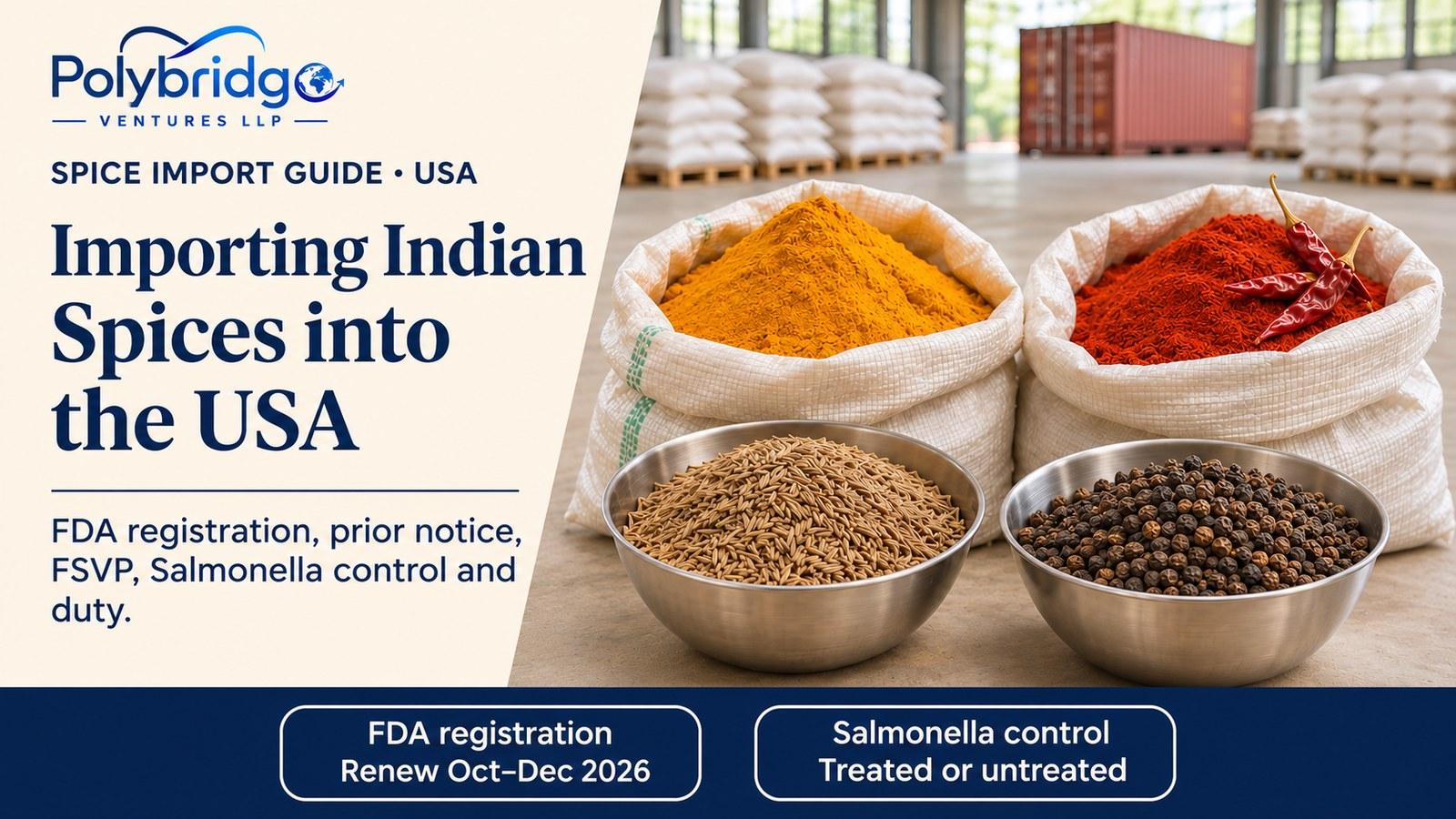
Quick answer: To import spices from India into the USA, the facility that processes and packs the spice must be registered with the FDA, and the registration must be renewed between 1 October and 31 December of every even year, including 2026. Each shipment needs FDA prior notice before it arrives, and the US importer must run a Foreign Supplier Verification Program (FSVP) for each spice and supplier. Salmonella is the main safety issue: agree whether the spice is treated with a validated kill step before shipment or will be treated in the USA. US buyers also commonly ask for lead and pesticide test reports. Most pepper and turmeric lines are duty-free under the normal US rate, but US tariffs on Indian goods changed several times in 2026, so confirm the duty for each line with your customs broker.
FDA rules that apply to imported spices
| Requirement | Who is responsible | What it means |
|---|---|---|
| Food facility registration | The facility in India that processes and packs the spice | Registration with the FDA before shipping to the USA, with a Unique Facility Identifier (a DUNS number) and a US agent. It must be renewed every even year between 1 October and 31 December; a registration not renewed by 31 December 2026 is treated as expired. |
| Prior notice | The importer or its broker | Filed with the FDA for every shipment before it arrives in the USA. |
| Foreign Supplier Verification Program (FSVP) | The US importer | The importer analyses the hazards in each spice, approves the supplier, verifies it, and re-evaluates the spice and supplier at least every three years. |
| Pathogen control (kill step) | The processor, or the US buyer if it treats the spice | Spices need a validated microbial reduction step to be ready to eat. If the kill step is applied in the USA, the US company takes responsibility for it. |
Salmonella: treated or untreated?
Salmonella is the bacterial pathogen most often linked to spice recalls and outbreaks, according to the American Spice Trade Association (ASTA). The common treatments are steam, irradiation and fumigation with ethylene oxide or propylene oxide, and the US Environmental Protection Agency sets residue tolerances for the fumigants. Steam is often used for whole spices such as black pepper.
Agree in the contract whether the spice is shipped already treated with a validated process, with the certificate for each lot, or shipped untreated for treatment by the buyer in the USA. Untreated spice should be labelled and documented as not ready to eat.
FDA import alerts to know
- Import Alert 99-19 allows detention without physical examination of food products found with Salmonella. It names spices among the foods it covers, and FDA updated it in November 2026.
- Import Alert 28-02 covers black pepper from India, whole and ground, for Salmonella and filth.
- Import Alert 99-08 covers processed foods held for pesticide residues.
- Lead: since 2024 FDA has issued public health alerts and recalls for ground cinnamon with elevated lead, and recalls continued in 2025 and 2026. Many US buyers now ask for a lead test report on turmeric, chilli and other ground spices.
A shipment from a firm on an import alert's "red list" can be detained without examination until the firm shows the problem is fixed, so it pays to buy from suppliers with a clean record and per-lot testing.
Import duty (as of October 2026)
| Item | What we found |
|---|---|
| Normal (MFN) duty | Black pepper whole and ground (0904.11, 0904.12) and turmeric (0910.30) are duty-free. Dried chilli has small specific duties: about 2.5 US cents/kg whole (0904.21.60) and 5 cents/kg ground (0904.22.76). Check the HTS line for cumin, coriander and other spices. |
| Extra duties on Indian goods | The IEEPA "reciprocal" tariffs ended in February 2026, and the Section 122 surcharge expired on 24 July 2026. A 10% Section 301 duty on goods of India applies from 24 July 2026, with exemptions that include pepper, chilli, cinnamon and turmeric lines. |
| India–US trade agreement | A framework was announced in February 2026, but no agreement with new rates was in force as of October 2026. |
The US tariff position on Indian goods changed several times in 2026 and parts of it are still in court. Confirm the full duty for each HTS line with a licensed customs broker before you sign a contract.
Documents we send with each shipment
- Commercial invoice and packing list
- Bill of lading or airway bill
- Certificate of origin
- Certificate of Analysis for the lot
- Test reports your FSVP needs, such as Salmonella, lead and heavy metals, pesticide residues and aflatoxin
- Treatment certificate, if the spice is treated before shipment
- The FDA registration details of the packing facility, for your broker's prior notice
- Phytosanitary certificate, if your buyer asks for one
Specifications to agree before you order
- Quality: for example, curcumin for turmeric, ASTA colour and heat for chilli, volatile oil for cumin, and moisture and mesh for powders.
- Cleanliness: many US buyers use ASTA cleanliness specifications for whole spices.
- Microbiology: Salmonella absent, and whether the spice is treated or untreated.
- Contaminants: your limits for lead, pesticide residues (to US tolerances) and aflatoxin.
- Packing and labels: bulk bags for further processing, or retail packs with US-compliant labels for private label.
Step-by-step: your first spice order from India
- Send us the spice, specification, quantity, packing and destination port.
- We send a quotation, the specification sheet, a sample and the documents for your supplier approval.
- Approve the sample and add us to your FSVP.
- Agree treatment, testing and the contract terms.
- We pack and ship, and send the documents and test reports for the lot.
- Your broker files prior notice and clears the goods with US Customs and FDA.
Buy Indian spices for the USA from Polybridge Ventures
Polybridge Ventures LLP exports bulk whole and ground Indian spices to importers, food manufacturers and private-label brands. Read our guides to turmeric powder for US buyers and black pepper powder for the USA, our step-by-step spice import guide and our spice HS code list, see turmeric powder, cumin powder and chilli powder, or request a quote.
Sources: FDA Constituent Update, "FDA Reminds Food Facilities of Biennial Renewal Requirements" (29 September 2026) and Food Facility Biennial Registration Renewal page; FDA, Final Rule on Foreign Supplier Verification Programs, At-A-Glance and Key Requirements; FDA Import Alerts 99-19, 28-02 and 99-08; FDA public health alerts on lead in ground cinnamon (2024–2026); American Spice Trade Association, Clean, Safe Spices guidance (2017 update) and treatment methods page; AirliftUSA, "US tariffs on India in 2026" (updated 5 October 2026); Spicemodo, "Cost to import spices from India" (updated 13 October 2026). This guide is for information only. Confirm current rules and duty rates with your customs broker and the FDA before importing.