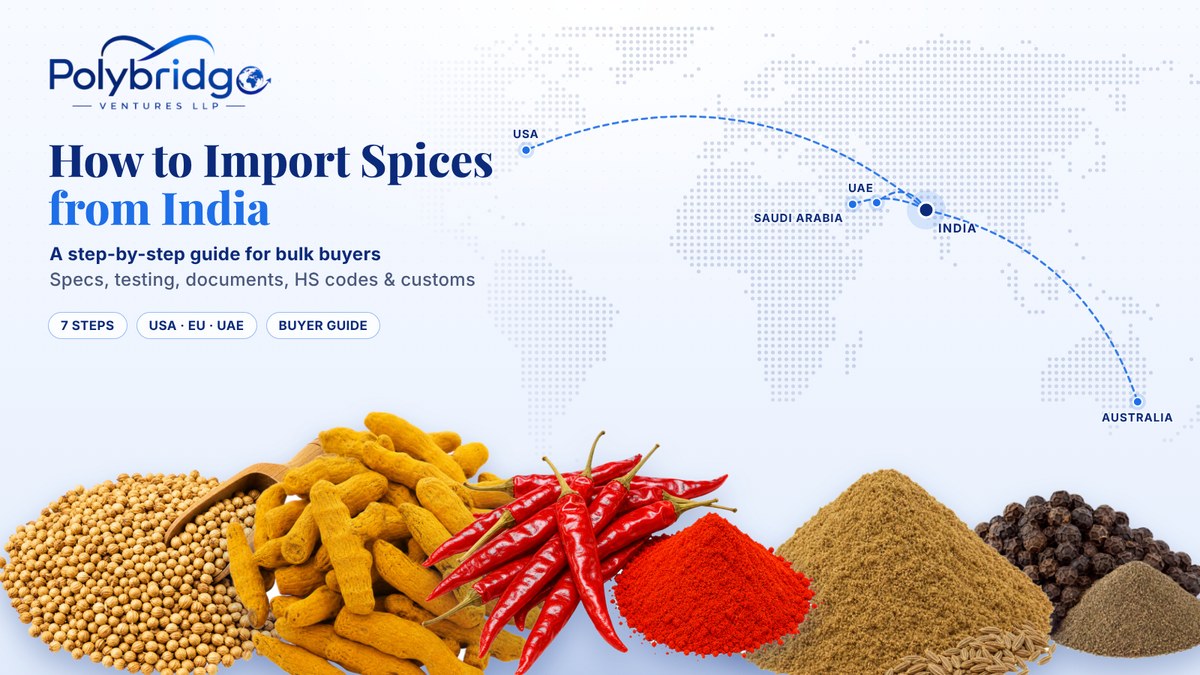
Quick answer: To import spices from India, (1) write a clear specification, (2) choose a registered Indian exporter and approve samples, (3) agree price, Incoterms and payment in a written quotation, (4) have each lot tested and packed to your requirements, (5) receive the export documents (invoice, packing list, bill of lading, certificate of origin, Certificate of Analysis and, where needed, a phytosanitary or health certificate), and (6) clear customs under your own country's food import rules. Most spice orders ship in 20 ft or 40 ft containers from major Indian ports such as Mundra, Nhava Sheva (JNPT), Hazira and Visakhapatnam.
This guide walks through each step for importers, food manufacturers, spice blenders and private-label brands buying in bulk. It is written by Polybridge Ventures LLP, a spice exporter based in Ahmedabad, Gujarat.
Why buyers source spices from India
India is the world's largest producer, consumer and exporter of spices. Most of the spices traded in bulk are grown in a few key regions, which is why origin and variety matter when you write a specification.
| Spice | Main growing regions in India |
|---|---|
| Cumin | Gujarat and Rajasthan |
| Fennel | Gujarat (traded at Unjha) and Rajasthan |
| Coriander | Rajasthan, Gujarat and Madhya Pradesh |
| Fenugreek | Rajasthan, Gujarat and Madhya Pradesh |
| Turmeric | Telangana, Maharashtra, Tamil Nadu, Andhra Pradesh and Meghalaya (Lakadong) |
| Red chilli | Andhra Pradesh, Telangana, Karnataka and Madhya Pradesh |
| Black pepper | Kerala and Karnataka |
Step 1: Write a clear specification
A precise specification is the single biggest factor in getting comparable quotes and avoiding disputes. Include at least:
- Product and form: botanical name, whole, crushed or ground, and variety or trade quality (for example Teja chilli, Singapore-quality fennel, 550 g/L black pepper).
- Physical limits: moisture, extraneous matter, broken or damaged seed, purity (machine-cleaned or sortex), and mesh size for powders.
- Quality markers: volatile oil, curcumin for turmeric, ASTA colour and heat (SHU) for chilli, piperine for pepper.
- Food safety: Salmonella, aflatoxin, pesticide residues, ethylene oxide (ETO) and, for chilli and turmeric, Sudan dyes, set to your market's limits.
- Packing and labelling: bag type and weight, inner liners, retail or private-label packs, and label language.
- Quantity and destination: tonnes or containers, delivery schedule and port of discharge.
If you work to a standard, name it, for example Codex, ISO, ASTA cleanliness specifications or Indian AGMARK grades. Our product pages list typical specifications for each spice: turmeric, cumin, chilli, black pepper, coriander and fennel.
Step 2: Choose and check an exporter
Before you place an order, ask the exporter for:
- Spices Board registration (Certificate of Registration as Exporter of Spices), which every Indian spice exporter must hold.
- Import Export Code (IEC), GST registration and FSSAI licence, the basic Indian business and food licences.
- FDA food facility registration for the packing facility, if you import into the United States.
- Recent lab reports for the product you want, from an accredited laboratory.
- Samples from current stock, sealed and labelled with a lot number.
Visit or appoint an inspection agency where order sizes justify it, and ask for references from buyers in your market.
Step 3: Approve samples and agree testing
Approve a pre-shipment sample against your specification before production. Agree in writing which tests the lot will have, which laboratory will run them and what happens if a result fails.
India's Spices Board also runs mandatory sampling and testing of export consignments for certain spice and destination combinations under its Quality Evaluation System. Depending on the product and market, this covers aflatoxin, Sudan dyes, pesticide residues, ethylene oxide and, for the USA, Salmonella. The list is updated by Spices Board circular, so confirm the current requirement for your product and country with your exporter.
Step 4: Get a written quotation
A good quotation states the agreed specification, price per kg or per tonne, quantity, packing, Incoterm, payment terms, dispatch date and the documents included.
| Incoterm | What the price includes |
|---|---|
| FOB (Free on Board) | Goods loaded on the vessel at the Indian port. You arrange and pay ocean freight and insurance. |
| CFR (Cost and Freight) | Goods delivered to your destination port, freight paid by the exporter. You arrange insurance. |
| CIF (Cost, Insurance and Freight) | As CFR, with the exporter also arranging marine insurance. |
Common payment terms are an advance payment with the balance against documents, cash against documents (CAD) through banks, or a letter of credit (LC) for larger orders. Agree terms before production starts.
Step 5: Packing and container loading
Bulk spices are usually packed in PP woven bags, jute bags or paper bags with food-grade inner liners, commonly 25 kg or 50 kg for whole spices and 20 kg to 25 kg for powders. Retail and private-label packs are filled and cartoned before loading.
How much fits in a container depends heavily on the product: dense powders and seeds load far more weight than bulky whole chillies. Ask your exporter for the expected net weight per 20 ft or 40 ft container for your product and packing. Ground spices lose aroma faster than whole spices, so agree liners, storage and shipping timelines that suit your shelf-life needs.
Step 6: Export documents
| Document | Purpose |
|---|---|
| Commercial invoice | Value of goods, used for customs clearance and duty |
| Packing list | Number of bags, weights and marks for each lot |
| Bill of lading | Shipping line's receipt and title document for the goods |
| Certificate of origin | Proves Indian origin; a preferential certificate can reduce duty where a trade agreement applies, such as India's agreements with the UAE and Australia |
| Certificate of Analysis (CoA) | Lab results for the lot against the agreed specification |
| Phytosanitary certificate | Issued by Indian plant quarantine, usually needed for whole seeds and other plant products |
| Health or official certificate | Required for some products and markets, for example certain spices entering the EU |
| Insurance certificate | Included when the sale is CIF |
Step 7: Clear customs in your country
Import rules are set by the destination country. The main points for our largest markets are:
United States
- The exporter's packing facility must be registered with the FDA, and registrations are renewed every two years.
- Prior Notice must be filed with the FDA before each shipment arrives.
- Under the Foreign Supplier Verification Program (FSVP), the US importer must verify that its foreign supplier meets US food safety standards.
- FDA can detain shipments that test positive for Salmonella or contain illegal pesticide residues, so testing before shipment matters.
European Union
- Pesticide residues must meet EU maximum residue levels, and ethylene oxide is not permitted.
- Aflatoxin limits apply to chilli, nutmeg, turmeric and several other spices.
- Under Regulation (EU) 2019/1793, some spices from India face increased border checks. From 30 June 2026, Indian cumin seeds face increased checks for pesticide residues, and certain dried spices need an official certificate with laboratory results.
United Arab Emirates and the Gulf
- The importer registers products and labels with the relevant food authority, such as Dubai Municipality, before or at first import.
- Retail packs need Arabic labelling with production and expiry dates.
- Shipments are inspected and may be sampled at entry.
Rules change, so confirm current requirements with your customs broker or food authority before each new product or market. For product-specific import notes, read our guides to turmeric powder for US buyers, black pepper powder for the United States, cumin powder for Dubai, red chilli powder for the UAE, whole dried red chilli for Dubai and whole turmeric for Dubai.
HS codes for common Indian spices
| Spice | Whole | Crushed or ground |
|---|---|---|
| Black pepper | 0904.11 | 0904.12 |
| Dried chilli (Capsicum) | 0904.21 | 0904.22 |
| Coriander | 0909.21 | 0909.22 |
| Cumin | 0909.31 | 0909.32 |
| Fennel | 0909.61 | 0909.62 |
| Turmeric | 0910.30 | |
| Curry powder and spice mixtures | 0910.91 | |
| Fenugreek and other spices | 0910.99 | |
These are the international six-digit codes. Your country adds further digits, and duty rates differ by market.
Typical timeline
- Enquiry to quotation: a few days, once the specification is clear.
- Samples: about one week by courier, plus your own evaluation time.
- Order to dispatch: often about a week for stock items, longer for custom packing, private label or extra testing.
- Ocean transit: from a few days to the Gulf to several weeks to Europe and North America, depending on the route and carrier.
Common mistakes to avoid
- Buying on price alone without a written specification, so lots vary in colour, purity or heat.
- Skipping pre-shipment testing for aflatoxin, pesticides, ETO or Salmonella, then facing rejection at the border.
- Not checking your own country's labelling and registration rules before the first shipment.
- Ordering ground spices too far ahead, so aroma is lost before use.
- Leaving Incoterms, payment terms or document lists unclear in the contract.
Import spices from India with Polybridge Ventures
Polybridge Ventures LLP exports bulk Indian spices, whole and ground, from Ahmedabad: turmeric, cumin, red chilli, black pepper, coriander, fennel, fenugreek and curry powder. Orders start at 1,000 kg, dispatch takes about 7 days for stock items, shipments leave from all major Indian ports, and every lot ships with a Certificate of Analysis. Send your specification for a quote.