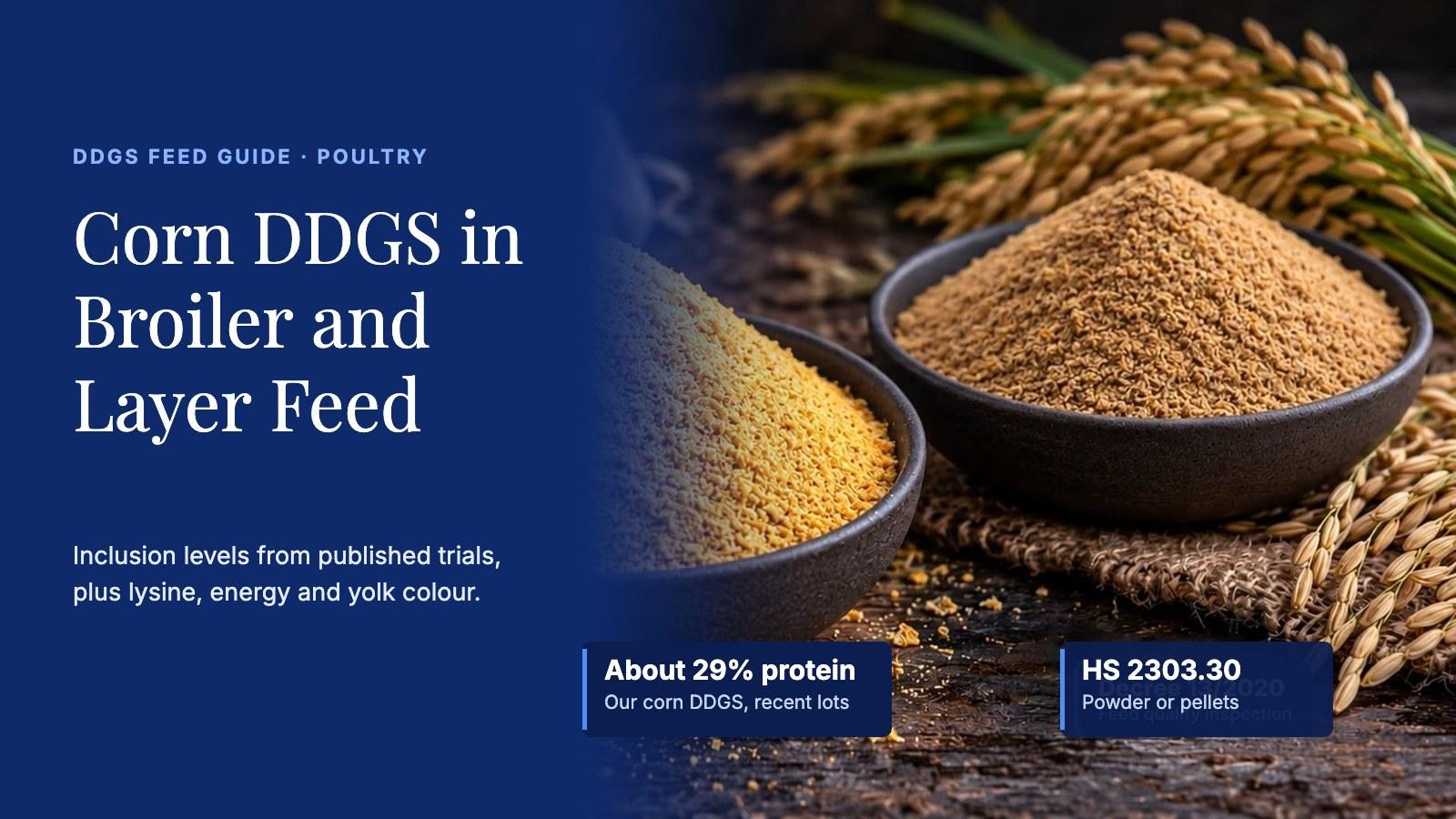
Quick answer: Published research supports corn DDGS at 10–20% of broiler diets over the whole growing period, and broilers performed well at up to 24% when diets were balanced on digestible amino acids. In laying hens, a University of Nebraska trial found no loss of egg production at up to 25%, and DDGS made yolks more yellow. The key is to formulate on the analysis of each lot, especially lysine and energy, and to check every lot for mycotoxins. Your nutritionist should set the final level.
Our corn DDGS: typical values
These are averages from independent laboratory tests on three recent lots of our corn DDGS. They are typical values, not a guaranteed specification, and each lot comes with its own test report.
| Parameter | Typical value |
|---|---|
| Crude protein | About 29% (28.6–29.3%) |
| Crude fat | About 10% (9.8–10.5%) |
| Crude fibre | About 8.4% |
| Moisture | About 7.5% |
| Aflatoxin | Tell us your limit; we confirm each lot before shipment |
With about 10% fat, corn DDGS supplies energy as well as protein, which suits poultry diets. If you mainly need protein, compare corn DDGS and rice DDGS.
Corn DDGS in broiler diets
| Study | Levels tested | Finding |
|---|---|---|
| Jang et al., 2020 (meta-analysis of 16 publications) | Various | Recommended 10–20% of the diet over the whole growing period. Above 20%, weight gain fell by about 1% and feed intake by about 2.5%. |
| Shim et al., 2011 | 0, 8, 16 and 24% | Broilers performed well at up to 24% when diets were balanced on digestible amino acids, with added lysine and threonine. Pellet durability fell as DDGS rose. |
| Earlier guidance, summarised in the DDGS User Handbook | – | 5–8% in starter diets and 12–15% in grower and finisher diets. The handbook calls these levels conservative, because they were based on total rather than digestible amino acids. |
The meta-analysis found the largest drop in weight gain in the starter phase, so a practical approach is a lower level in starter feed and a higher level in grower and finisher feed.
Corn DDGS in layer diets
Researchers at the University of Nebraska fed laying hens diets with 0, 5, 10, 15, 20 and 25% corn DDGS from week 24 to week 76 (Masa'deh et al., 2011):
- Feed intake and egg production were not affected at any level.
- Egg weight fell slightly as DDGS rose in the first phase (weeks 24–46), but not in the second phase.
- Egg quality, measured as Haugh units, did not change.
- Yolk colour rose steadily with DDGS, reaching 7.2 on the Roche colour fan at 25%.
The researchers concluded that producers can safely use up to 15% corn DDGS in layer diets, and possibly up to 25%.
Yolk colour: a bonus for layers
Corn DDGS contains the yellow pigments lutein and zeaxanthin (xanthophylls), at about 30–56 mg/kg according to the DDGS User Handbook. A meta-analysis cited in the handbook found yolk colour improved by about 18% when DDGS was fed. This can reduce the amount of added pigment a layer feed needs.
How to formulate with corn DDGS
- Use digestible amino acids. Lysine is the most variable amino acid in DDGS, because heat during drying can damage it. Formulate on standardised ileal digestible (SID) values, and add L-lysine and threonine as the inclusion rises.
- Estimate energy from the lot analysis. The handbook advises against old book energy values for DDGS. Use prediction equations based on the lot's fat, fibre and ash.
- Account for phosphorus. Corn DDGS contains more phosphorus than corn, so it can replace part of the inorganic phosphate in the diet. Use the lot analysis.
- Watch sodium and sulphur. Some DDGS is high in sodium or sulphur, which can cause wet litter at high inclusion. Ask for these values and adjust added salt.
- Check pellet quality. Higher DDGS levels can reduce pellet durability, so run a trial batch on your pellet mill.
Mycotoxins: test every lot
Mycotoxins in the grain end up concentrated in DDGS, at up to about three times their level in the original corn. Ask for a test report for aflatoxin and any other mycotoxins your market controls. For our corn DDGS, tell us the aflatoxin limit your mill or country requires, and we will confirm whether a lot meets it before shipment.
What about rice DDGS in poultry?
Rice DDGS is the high-protein, low-fat option. Indian research has found it can be used at up to 10% of broiler diets and 7.5% of layer diets, as covered in our corn vs rice DDGS comparison. A 2026 Indian trial got the best broiler growth at 12.5% rice DDGS with an added enzyme. For fish and shrimp, see rice DDGS in shrimp and fish feed.
Buying corn DDGS from India
We export corn DDGS under HS code 2303.30, as powder (meal) or pellets, packed in 50 kg woven PP bags or jumbo bags (FIBC). The minimum order is one full container load, and a laboratory test report comes with every lot. For import rules by country, see our guides for Bangladesh, Vietnam, Indonesia and the Philippines, or the main DDGS import guide.
To get a quotation, test report and sample, contact us.
Sources
- Jang J.C., Zeng Z., Urriola P. and Shurson G. (2020). Effects of feeding diets containing corn DDGS on growth performance in broilers: a meta-analysis. Abstract, Midwest Section of the American Society of Animal Science.
- Shim M.Y., Pesti G.M., Bakalli R.I., Tillman P.B. and Payne R.L. (2011). Evaluation of corn distillers dried grains with solubles as an alternative ingredient for broilers. Poultry Science 90(2): 369–376.
- Masa'deh M., Purdum S. and Hanford K. (2011). Dried distillers grains with solubles in laying hen diets. Poultry Science 90: 1960–1966. Summary: DDGS inclusion in layer diets, Canadian Poultry.
- DDGS User Handbook, Chapter 18: Reduced-oil DDGS in broiler and layer diets. U.S. Grains Council.
- Jones F. Avoiding mycotoxins in corn feedstock and DDGS. WATTPoultry.
- Sachin, Devasena B., Suryanarayana M.V.A.N. and Shakila S. (2026). Effect of dietary inclusion of rice distillers dried grains solubles with or without enzyme on growth performance and cost economics in broiler chickens. Indian Journal of Animal Nutrition 43(2).
Inclusion levels are from published research and are a starting point only. Results depend on the bird, its age, the rest of the formula and the lot analysis. Confirm levels with your nutritionist.