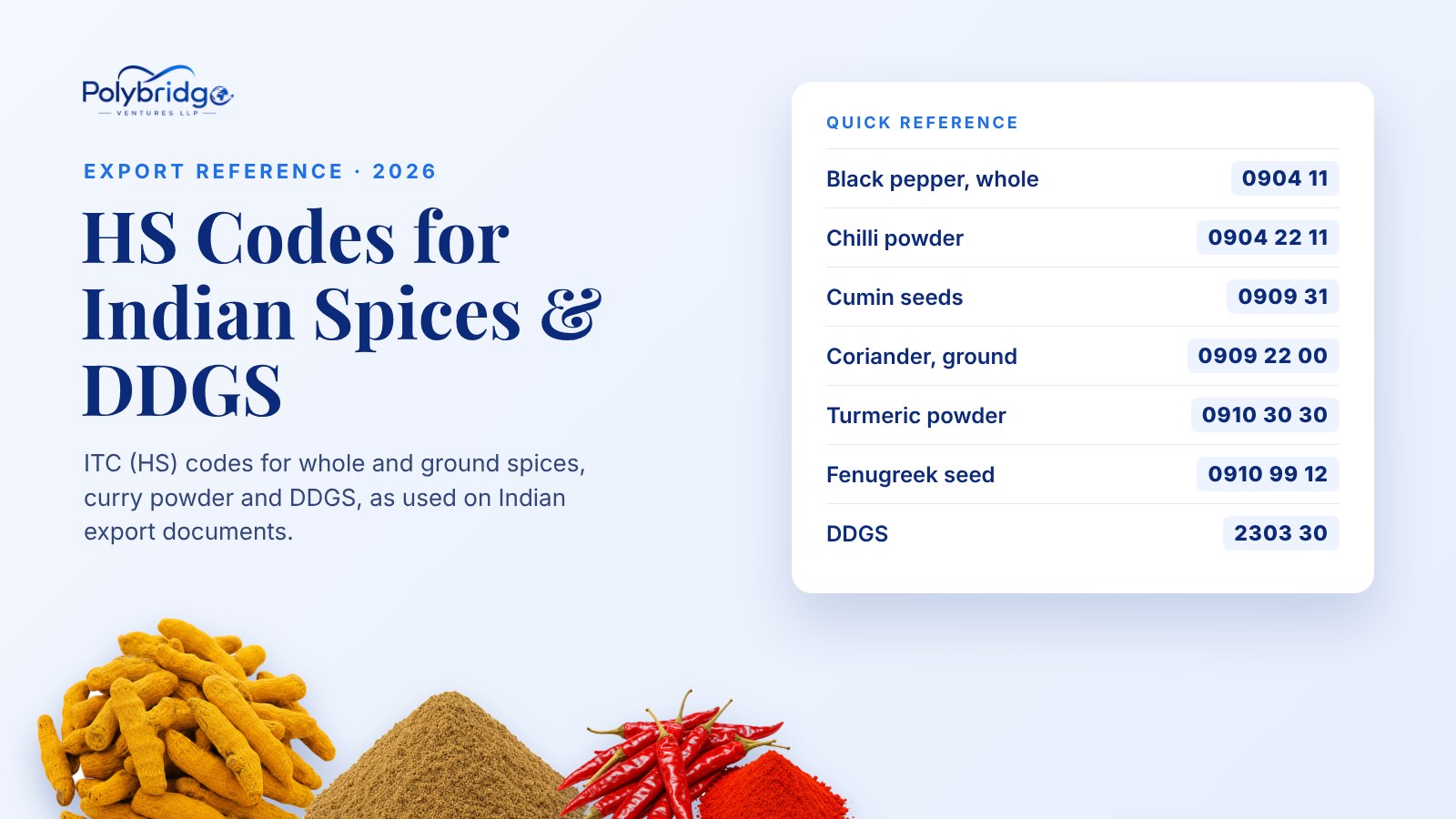
Quick answer: Indian spices fall under Chapter 9 of the Harmonized System: pepper and chilli under heading 0904, coriander, cumin and fennel under 0909, and turmeric, fenugreek and spice mixtures such as curry powder under 0910. DDGS falls under 2303.30 in Chapter 23. The first six digits are the same worldwide. India adds two more digits (the ITC (HS) code) that separate whole from ground spice and, for some products, seed quality from other grades. Your own customs authority adds its own national digits after the first six.
This reference lists the codes Polybridge Ventures LLP uses on export documents for the products we ship from India. The 8-digit codes follow the ITC (HS) classification published by the Spices Board of India, effective 1 April 2023.
How HS codes for spices are built
- Chapter (2 digits): 09 covers coffee, tea, maté and spices.
- Heading (4 digits): for example 0909 for coriander, cumin, fennel and similar seeds.
- Subheading (6 digits): the international level, usually split into "neither crushed nor ground" (whole) and "crushed or ground" (powder).
- India's ITC (HS) code (8 digits): used on Indian shipping bills and export invoices.
Whole and ground forms of the same spice nearly always have different codes. Use the code for the form you are actually shipping.
HS codes for Indian spices
| Product | Form | International (6-digit) | India ITC (HS) (8-digit) |
|---|---|---|---|
| Black pepper | Whole, garbled | 0904.11 | 0904 11 30 |
| Black pepper | Whole, ungarbled | 0904.11 | 0904 11 40 |
| Black pepper powder | Crushed or ground | 0904.12 | 0904 12 00 |
| Dried red chilli | Whole, dried | 0904.21 | 0904 21 10 |
| Red chilli powder | Crushed or ground | 0904.22 | 0904 22 11 |
| Coriander seeds | Whole (not of seed quality) | 0909.21 | 0909 21 90 |
| Coriander powder | Crushed or ground | 0909.22 | 0909 22 00 |
| Cumin seeds | Whole (not of seed quality) | 0909.31 | 0909 31 29 |
| Cumin powder | Crushed or ground | 0909.32 | 0909 32 00 |
| Fennel seeds | Whole (not of seed quality) | 0909.61 | 0909 61 39 |
| Fennel powder | Crushed or ground | 0909.62 | 0909 62 30 |
| Turmeric | Whole, dried | 0910.30 | 0910 30 20 |
| Turmeric powder | Powder | 0910.30 | 0910 30 30 |
| Fenugreek | Seed | 0910.99 | 0910 99 12 |
| Fenugreek powder | Powder | 0910.99 | 0910 99 24 |
| Curry powder | Mixture of spices | 0910.91 | 0910 91 00 |
Spices sold "of seed quality" (for sowing) use separate codes, for example 0909 31 21 for cumin and 0909 21 10 for coriander. Food-grade spices for processing and retail use the "other" codes shown above.
HS code for DDGS
| Product | International (6-digit) | Description |
|---|---|---|
| DDGS (corn or rice) | 2303.30 | Brewing or distilling dregs and waste |
Corn and rice DDGS use the same subheading. Some importing countries, such as Bangladesh, attach licence and certificate requirements to 2303.30 when it is imported as feed. See our DDGS buyer's guide for the documents by market.
Curry powder: 0910.91 or 2103.90?
A dry blend made only of spices from headings 0904 to 0910, such as turmeric, coriander, cumin, chilli and fenugreek, is classified under 0910.91 as a mixture of spices. A blend with significant added salt, starch, flour or other non-spice ingredients may instead fall under 2103.90 as a mixed condiment or seasoning. Check the ingredient list against your customs authority's rules before the first shipment.
Common mistakes to avoid
- Using the whole-spice code for powder: ground cumin is 0909.32, not 0909.31.
- Mixing up fennel and anise: both sit in 0909.61 and 0909.62 internationally, but national codes split them. Name the product as fennel seed on every document.
- Copying another country's national digits: only the first six digits are shared. Your import declaration needs your own country's full code.
- Different codes on different documents: the invoice, packing list, certificate of origin and phytosanitary certificate should all show the same code and description.
Where the HS code appears on export documents
- Commercial invoice and packing list
- Indian shipping bill
- Certificate of origin (needed to claim trade-agreement duty rates)
- Phytosanitary certificate, where the importing country requires one
- Your import declaration and any import licence or permit
For the full export process, from specification to clearance, read our step-by-step guide to importing spices from India.
Check before you ship
Tariff codes are revised from time to time, and customs authorities sometimes classify the same product differently. Confirm the full code and duty rate with your customs broker or tariff database before your first order. We include the HS code on every quotation and invoice, so you can check it in advance. To get a quote with the right codes for your products, contact us.